Overview
I am a skilled bioinformatician and software developer with 10+ years of academic and industry experience working at a bioinformatics CRO performing, reporting and communicating analyses for external stakeholders. I headed the R&D team, designing and engineering a large internal codebase to harness R and python to simplify and automate analyses and facilitate the analyst pool’s ability to work in a cost-efficient and error-free manner. This work allowed me to both manage and directly contribute to a broad repertoire of projects, developing technical expertise in bioinformatics, biology, -omics technologies, statistics, programming, DevOps, and cloud platforms including AWS, amongst others. I am an excellent written and verbal communicator, with extensive experience in client-facing communication, team leadership and wider strategic technical leadership.
I received my PhD from the University of Edinburgh’s Institute of Genetics and Cancer, with a specialty in the applied bioinformatics of cancer. I had the privilege of working closely with clinicians and patients to profile patient-derived tumour material to better understand the mechanism of breast cancer treatment resistance, resulting in several publications in high-impact journals. In addition to my professional career, I’ve maintained a small but consistent publication record, providing technical expertise for several academic projects.
Beyond science I had the pleasure of several years experience as a chef in Lyon, France and now live in Edinburgh with my wife, two children, two rescue dogs and our cat. I’m a keen chess player currently playing over-the-board for the Pentland Hills Chess Club.
Details
Education
2014-2018 PhD at Institute of Genetics and Cancer, University of Edinburgh, UK. Supervisor : Dr. Andrew Sims. Provisional thesis : ‘Considerations for robust transcriptomic analysis in breast cancer prediction and treatment’.
2011-2012 MSc (distinction) in Cancer Cell and Molecular Biology, University of Leicester, UK. Research project : ‘MicroRNA induction profiling as a result of low-dose doxorubicin treatment in MCF-10A mammary epithelial cells’
2007-2010 BSc 2.1 w/ Hons University of Nottingham. Research project : ‘The Role of Nuclear b-Arrestin in the Dephosphorylation of STAT1’
Publications
Pearce, DA, Ajit J. Nirmal, Tom C. Freeman, Andrew H. Sims. Continuous Biomarker Assessment by Exhaustive Survival Analysis. bioRxiv
Abstract
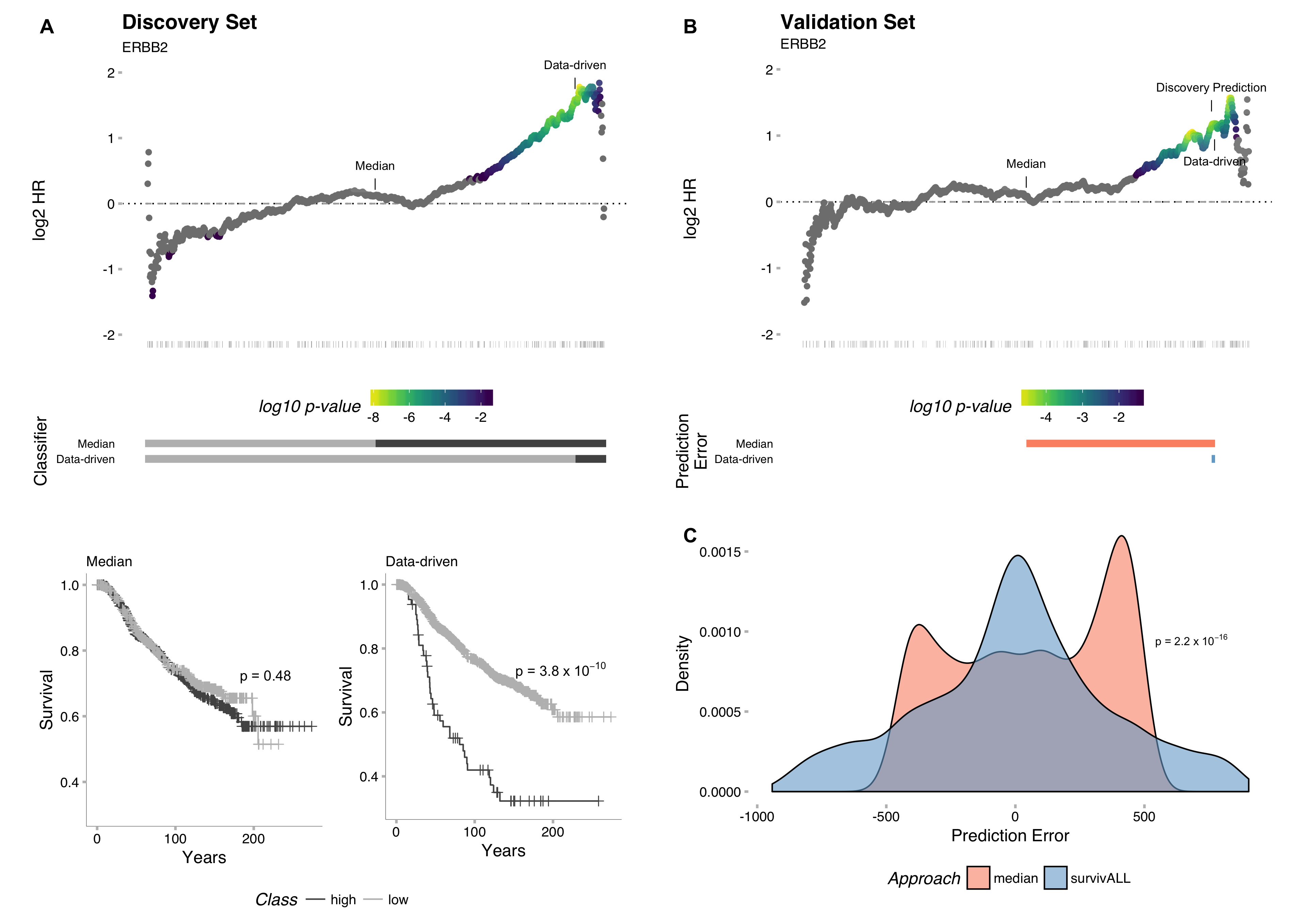
Publicly available high-throughput molecular data can enable biomarker identification and evaluation in a meta-analysis. However, a continuous biomarker’s underlying distribution and/or potential confounding factors associated with outcome will inevitably vary between cohorts and is often ignored. The survivALL R package (https://CRAN.R-project.org/package=survivALL) allows researchers to generate visual and numerical comparisons of all possible points-of-separation, enabling quantitative biomarkers to be reliably evaluated within and across datasets, independent of compositional variation. Here, we demonstrate survivALL’s ability to robustly and reproducibly determine an applicable level of gene expression for patient prognostic classification, in datasets of similar and dissimilar compositions. We believe survivALL represents a significant improvement over existing methodologies in stratifying patients and determining quantitative biomarker(s) cut points for public and novel datasets.
Pearce, D. A. et al. Tumour sampling method can significantly influence gene expression profiles derived from neoadjuvant window studies. Sci. Rep, 2016.
Abstract
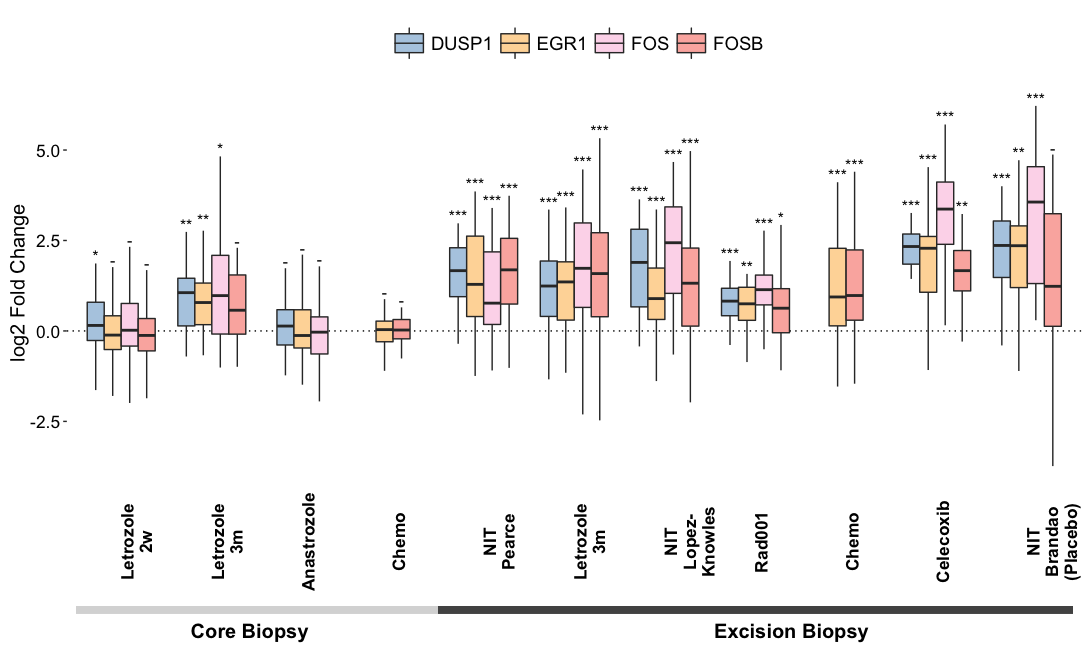
Patient-matched transcriptomic studies using tumour samples before and after treatment allow inter-patient heterogeneity to be controlled, but tend not to include an untreated comparison. Here, Illumina BeadArray technology was used to measure dynamic changes in gene expression from thirty-seven paired diagnostic core and surgically excised breast cancer biopsies obtained from women receiving no treatment prior to surgery, to determine the impact of sampling method and tumour heterogeneity. Despite a lack of treatment and perhaps surprisingly, consistent changes in gene expression were identified during the diagnosis-surgery interval (48 up, 2 down; Siggenes FDR 0.05) in a manner independent of both subtype and sampling-interval length. Instead, tumour sampling method was seen to directly impact gene expression, with similar effects additionally identified in six published breast cancer datasets. In contrast with previous findings, our data does not support the concept of a significant wounding or immune response following biopsy in the absence of treatment and instead implicates a hypoxic response following the surgical biopsy. Whilst sampling-related gene expression changes are evident in treated samples, they are secondary to those associated with response to treatment. Nonetheless, sampling method remains a potential confounding factor for neoadjuvant study design.
Other selected publications
- Moir, N, Pearce, D. A, Langdon, S. P & Simpson, I. The significance of molecular heterogeneity in breast cancer batch correction and dataset integration. Breast Cancer Research, 2025.
- Ross, K. E., Pearce, D. A, McMillan, K. M. What Patterns in Online Classified Puppy Advertisements Can Tell Us about the Current UK Puppy Trade. Animals, 2023.
- Selli, C., Pearce, D.A., Sims, A.H. et al. Differential expression of store-operated calcium- and proliferation-related genes in hepatocellular carcinoma cells following TRPC1 ion channel silencing. Mol Cell Biochem, 2016.
Achievements
- Recipient of the British Association of Cancer Research Travel Fellowship. A 3-month funded collaboration with Professor Robert Clarke at Georgetown University, Washington DC.
- Poster Award from BACR ‘Bridging gaps in breast cancer research’ conference, Newcastle/Gateshead, UK.
- Junior Scientist Travel Grant awarded from The Genetics Society
- European Association of Cancer Research
- Demonstrator and organiser with Edinburgh International Science Festival ‘From Code to Cure’
- Founder of puzzlesANDpie, a coding club within the University of Edinburgh